
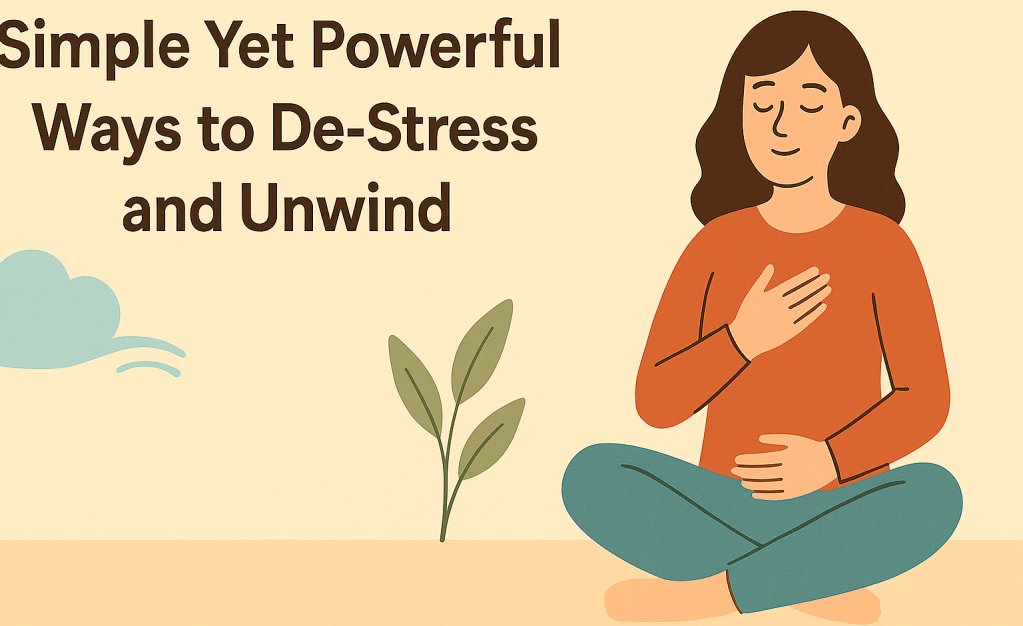
We all face stress in our lives — sometimes it’s mild and manageable, and other times it feels overwhelming. Whether it’s due to work, studies, relationships, or just the pace of daily life, stress, anxiety, and sadness are all part of being human. But while we can’t always control the sources of stress, we can learn how to manage our response to it.
The good news is that relaxation doesn’t always require fancy techniques or long retreats. Sometimes, the simplest practices can make the biggest difference in calming our mind and body. Let’s explore a few practical and effective ways to de-stress that you can easily use anytime, anywhere.
1. Deep Breathing — The Simplest Stress Reliever
When stress hits, our breathing naturally becomes shallow and fast. This is part of the body’s “fight or flight” response, which prepares us to react to danger. But when that stress isn’t a real physical threat — just a mental or emotional one — our body still reacts the same way. Deep breathing helps reverse this reaction.
Here’s a simple technique you can try right now:
- Breathe in through your nose for 4 seconds
- Hold your breath for 4 seconds
- Breathe out slowly through your nose for 4 seconds
Repeat this cycle at least three to five times — or more, if needed — until you feel your body start to relax.
This technique, often called “box breathing,” works by sending a message to your brain that you are safe. Your heart rate slows down, your muscles loosen, and your thoughts begin to settle. Within a few minutes, you’ll notice that your mind feels clearer and your body lighter.
You can do this anywhere — while sitting at your desk, lying in bed, or even in a stressful social situation. It’s like pressing the pause button on anxiety.
2. Grounding Through the Five Senses — Connecting with the Present
Sometimes, however, stress goes beyond our daily level of tension. These are the moments when we feel lost in our thoughts, overwhelmed by emotions, or disconnected from the present. That’s when grounding techniques can be especially helpful.
One of the most effective grounding exercises is to activate your five senses — sight, sound, smell, touch, and taste. This practice brings your attention back to the here and now, pulling your focus away from racing thoughts and worries.
Here’s a simple version you can try:
- Look around you. Notice what’s in your surroundings — the shapes, colours, or details. It could be anything: the texture of the wall, the pattern on your shirt, or the movement of leaves outside. Try to observe without judging whether it’s beautiful or not.
- Listen. Pay attention to the sounds around you. It could be the hum of a fan, birds chirping, or distant traffic. Let the sounds be there without labelling them as “good” or “bad.”
- Smell. Take a slow breath and see if you can notice any scents nearby — perhaps your cup of tea, a candle, or even the smell of the air. If there’s nothing noticeable, you can create one — apply a little perfume or hold a cup of coffee near your nose.
- Touch. Focus on the sensation of touch. Feel the surface you’re sitting on, the fabric of your clothes, or your own hands. You can rub your palms together gently or hold an object with an interesting texture — like a soft cushion or a smooth stone.
- Taste. If you have something to eat or drink, take a small sip or bite. Pay attention to its flavour and texture. Even chewing gum or a mint can serve this purpose.
This technique gently guides your mind out of anxiety and into awareness. You’ll notice your thoughts slowing down, and your body starting to feel anchored again.
3. Why These Techniques Work
Both deep breathing and sensory grounding work because they shift our focus from thinking to experiencing. Stress often pulls us into the past (regret, guilt) or the future (fear, worry). These exercises bring us back to the present moment — the only place where calm truly exists.
Breathing deeply sends oxygen to the brain, signalling safety and calm. Activating the senses engages parts of the brain responsible for physical awareness, helping to interrupt cycles of anxiety and overthinking. In short, these techniques help your mind and body remember that you are safe right now.
4. A Gentle Reminder
Managing stress doesn’t mean eliminating it completely — it’s about learning to respond differently. When you practise these techniques regularly, your body becomes more resilient, and stressful situations stop feeling as overwhelming.
So, the next time you feel anxious or burdened, pause. Take a deep breath. Look around. Feel the texture of what’s in your hands. Notice the sound of your surroundings. These small moments of mindfulness are like tiny acts of kindness you offer yourself.
Remember: relaxation is not a luxury — it’s a form of self-care and self-preservation.

 Mind's Maze and Beyond
Leave a comment